 how-to
How to Verify Ethiopian News Sources
Table of Contents
- Why Verifying Ethiopian News Sources Matters
- Understanding State-Affiliated vs. Independent Media
- Step 1: Check Editorial Independence and Funding Disclosure
- Step 2: Use Reverse Image Search and Metadata Analysis
- Step 3: Cross-Reference News Across Multiple Outlets
- How to Identify Misinformation in News Reports
- Recognizing Political Bias and Ethiopian Media Bias Analysis
- Conclusion
- Frequently Asked Questions
Last Updated: October 2, 2026
Why Verifying Ethiopian News Sources Matters
The media environment in Ethiopia has become increasingly polarized, with frequent arrests of journalists and significant pressure on independent reporting. This reality makes it essential for readers worldwide to understand how to verify Ethiopian news sources with precision and care.
With 9.8 million social media users in Ethiopia as of October 2025, representing 7.2% of the population, misinformation spreads rapidly across digital platforms. The challenge is compounded by the fact that the BTI 2026 Ethiopia Country Report documents how authoritarian political contexts create barriers to traditional fact-checking methods.
For the Ethiopian diaspora and globally engaged readers, learning to verify Ethiopian news sources is essential, a single unverified story can shape your understanding of events that matter deeply.
Verification is learnable and works even when journalism faces institutional pressure. Below, we'll show you how to distinguish credible reporting from propaganda, political bias, and falsehoods.
Understanding State-Affiliated vs. Independent Media
The first step in learning to verify Ethiopian news sources is recognizing the structural difference between state-controlled outlets and independent journalism. This distinction shapes what gets reported and how stories are framed.
State-affiliated outlets receive government funding and prioritize official narratives. Independent outlets rely on subscription revenue, advertising, or donor funding that doesn't require government approval.
Look for: Ownership transparency (who owns and funds it?), Editorial corrections (do they publish retractions?), Diverse sources (do stories include opposing voices?), and Bylines (are reporters named?). State-affiliated outlets publish unsigned editorials aligned with government positions; independent outlets show editorial independence through coverage that sometimes contradicts powerful interests.
Step 1: Check Editorial Independence and Funding Disclosure
Investigate who funds the outlet by checking: Ownership information, Funding sources (subscriptions, advertising, grants?), Editorial policy (corrections standards?), and Staff bios. If an outlet won't disclose funding, that's a red flag, legitimate independent outlets are transparent about financial backing.
According to the Global Forum for Media Development Impact report, outlets that practice transparent funding disclosure tend to have stronger community trust and better verification protocols. This matters because transparency correlates with editorial independence.
Ask yourself: Would this outlet benefit politically or financially from a particular story? If the answer is yes, treat their coverage with extra scrutiny.
Step 2: Use Reverse Image Search and Metadata Analysis
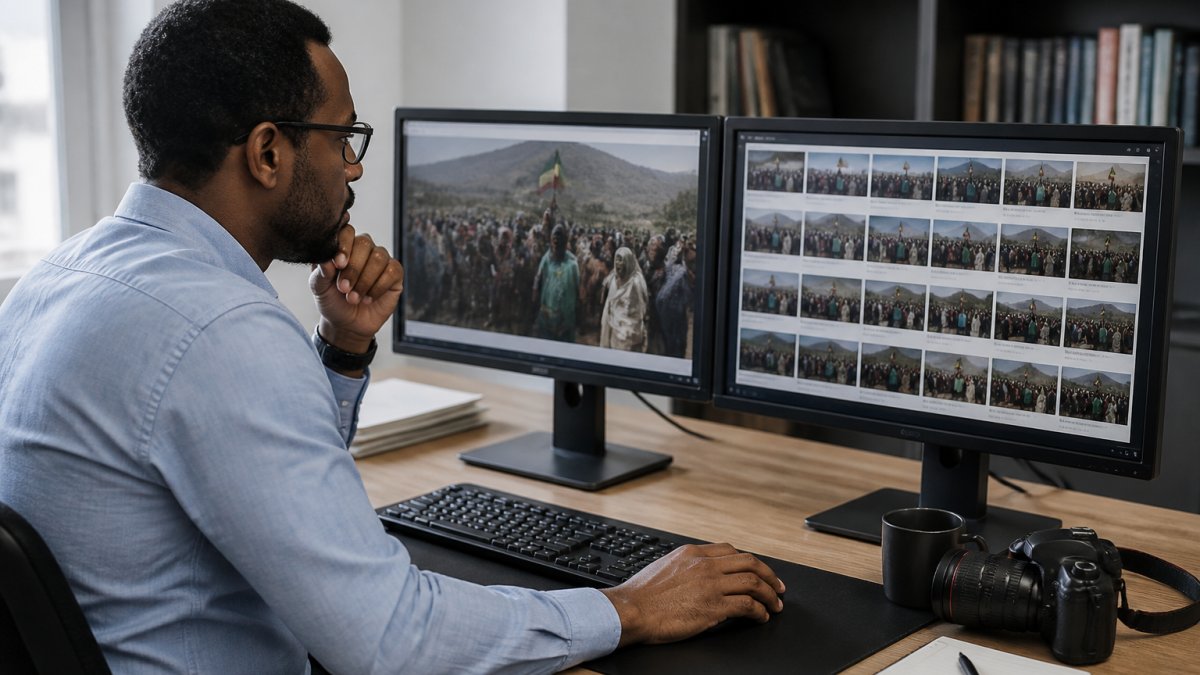
Images are often the most manipulated element in misinformation campaigns. A single photo can be recycled, doctored, or taken out of context to support false narratives. This is especially true in conflict reporting, where images from past events are frequently republished as current news.
Reverse image search is your most powerful verification tool. Save the image, go to Google Images (images.google.com), click the camera icon, and upload the image. If a photo supposedly from a recent event appears in articles from years ago, the image is recycled. If it appears on multiple outlets with different captions, context is being manipulated.
Free tools: Google Lens (identifies similar images and publication history), TinEye (specialized reverse search), Exif.tools (extracts metadata like camera type, date, GPS coordinates), and InVID & We Verify (browser extension for conflict-zone verification).
Metadata analysis goes deeper. Every digital image contains hidden information: the camera type, date taken, location coordinates, and more. Tools like Nieman Lab's verification guide for high-risk environments recommend using free metadata viewers to check if timestamps align with the story's narrative.
Common manipulation patterns: Recycled conflict imagery (photos from 2020 republished as 2024), cropped context removal (hiding peaceful context), geographic mislabeling, stock photos passed as original reporting, and metadata stripping (absence of EXIF data is a red flag).
When verifying images in Amharic or Oromo captions, use reverse image search first to establish the image's true origin, then verify the caption independently, captions in local languages are frequently mistranslated or misattributed across diaspora networks.
Verification workflow: Run reverse image search, check metadata, cross-reference publication dates with story claims, verify caption consistency across outlets, and search local language outlets for context differences.
Step 3: Cross-Reference News Across Multiple Outlets
Cross-referencing builds an accurate picture and reveals where bias enters reporting.
Details appearing in all outlets are likely factual; details in only one outlet may be speculation. Headlines reveal framing: "government cracks down" versus "security forces respond" show different perspectives. Credible outlets name specific sources; those using "sources say" ask you to trust their judgment rather than verify independently.
| Outlet | Key Claim | Source Named? | Evidence Provided? |
|---|---|---|---|
| Outlet A | Event occurred on date X | Yes, named official | Yes, with quote |
| Outlet B | Event occurred on date X | No, "sources say" | No, general description |
| Outlet C | Event occurred on date X+1 | Yes, named witness | Yes, with timeline |
How to Identify Misinformation in News Reports
Misinformation often wears the costume of legitimate journalism with proper formatting and official-sounding language. Learning the tells takes practice, and patterns differ across languages.
How misinformation spreads differently in diaspora networks:
-
Diaspora-specific misinformation, Claims about family members' safety, neighborhood violence, or government actions spread rapidly through WhatsApp groups. These claims often lack publication dates or named sources. Verify by asking: "Did this person publish this claim on their own social media or through a news outlet?" If it's only circulating in private groups, it's unverified rumor, not news.
-
Emotional amplification in translation, When stories are translated from Amharic to English for diaspora sharing, emotional language is often added or intensified. Compare the original Amharic article to the English translation circulating on social media. Discrepancies reveal where misinformation has been introduced.
-
Conflicting narratives across languages, The same event may be described differently in Amharic versus English outlets due to different editorial perspectives or audience assumptions. This is not necessarily misinformation, but it signals that you need to read both versions to understand the full picture.
Practical verification workflow when you encounter a suspicious claim:
- Identify the language, Is the claim in Amharic, Oromo, Tigrinya, or English? This determines which outlets and tools you'll use to verify.
- Search for the claim in multiple languages, Use Google to search the same claim in English, Amharic, and other relevant languages. If it appears in only one language, it's likely unverified.
- Check the source's track record, Has this outlet or person made false claims before? Search their name plus "misinformation" or "false claim" to see if they have a history.
- Look for named sources and dates, Credible reporting includes specific people, organizations, and timestamps. Misinformation relies on vague attribution ("sources say") and missing dates.
- Cross-reference with international outlets, For major events, check whether international news agencies (Reuters, Associated Press, BBC, Al Jazeera) are reporting the same story. If they're not, the claim may be unverified or false.
- Ask what you would need to verify the claim, Then search for that evidence. If you can't find it after a reasonable search, the claim is unverified.
Recognizing Political Bias and Ethiopian Media Bias Analysis
Every outlet has a perspective. The question isn't whether bias exists, it's whether the outlet acknowledges it and reports facts accurately despite their perspective.
Editorial bias appears in story selection, framing, and emphasis:
- Which stories get front-page placement?
- Are opposing viewpoints included and fairly represented?
- Do headlines accurately reflect the article content, or do they sensationalize?
- Are sources from different political perspectives included?
Language bias appears in word choice:
- "Security forces" vs. "military occupation"
- "Protesters" vs. "rioters"
- "Government initiative" vs. "government overreach"
Conclusion
Verifying news sources is a skill that improves with practice. Start with one technique, reverse image search, perhaps, and master it before adding others. The goal isn't to become a professional fact-checker; it's to read with intention rather than acceptance.
Frequently Asked Questions
How can I distinguish between independent and state-affiliated Ethiopian media?
Independent outlets typically disclose their funding sources, editorial board, and ownership structure transparently. State-affiliated media often lacks this transparency and may align messaging with government positions. Check the outlet's website for an 'About Us' page listing founders, funders, and editorial leadership.
What are the best practices for verifying news reports from Ethiopia?
Use reverse image searches to confirm photo authenticity, check metadata for timestamps and location data, and cross-reference stories across multiple independent outlets. Verify journalist credentials and publication dates. Look for primary sources and direct quotes rather than secondhand accounts. Examine whether the outlet discloses potential conflicts of interest and maintains editorial independence from political or corporate pressure.
How do I identify bias in Ethiopian political reporting?
Watch for language that favors one political group over others, selective reporting that ignores opposing viewpoints, and framing that presents opinion as fact. Reliable outlets use neutral language, cover multiple perspectives, and clearly separate news from analysis. Compare how different outlets cover the same event, significant differences in tone or emphasis suggest bias. Check whether the outlet covers all ethnic and regional communities fairly or focuses heavily on one group.
What role does social media play in spreading misinformation about Ethiopia?
Social media accelerates misinformation because posts spread rapidly without editorial review. With 9.8 million social media users in Ethiopia as of late 2025, false information can reach millions quickly. Users often share unverified claims, manipulated images, and rumor as fact. Deepfakes and AI-generated content increasingly appear on platforms. Before sharing posts about Ethiopian politics or conflicts, verify the source, check if the image is authentic using reverse search, and confirm the story appears in established news outlets with editorial standards.