 ultimate-guide
Impact of Diaspora Media on Ethiopia: A 2026 Guide
Table of Contents
- How Diaspora Media Became a Force in Ethiopian Politics
- Ethiopian Diaspora Social Media: Engagement Without Borders
- Diaspora Media and Misinformation: The Double-Edged Sword
- Ethiopian Diaspora News Sources: Who to Trust and Why
- Positive Impacts: Advocacy, Diplomacy, and Nation Building
- Risks and Limits: Polarization, Hate Speech, and Audience Gaps
- Conclusion: What the Evidence Says About Diaspora Media's Role
- Frequently Asked Questions
Last Updated: October 5, 2026
How Diaspora Media Became a Force in Ethiopian Politics
Diaspora media is the network of satellite channels, radio programs, websites, and social platforms run by and for Ethiopians living outside the country, and its impact on Ethiopia now reaches from daily political debate to formal diplomacy. At The Habesha, we have watched that network grow from a handful of exile broadcasts into a system that shapes how millions follow home.
The shift happened in stages. Satellite television first gave exiled journalists a way to broadcast in Amharic and Afaan Oromo without a license from Addis Ababa. Radio followed, then websites, then Facebook and X, each step lowering the cost of reaching an audience across borders.
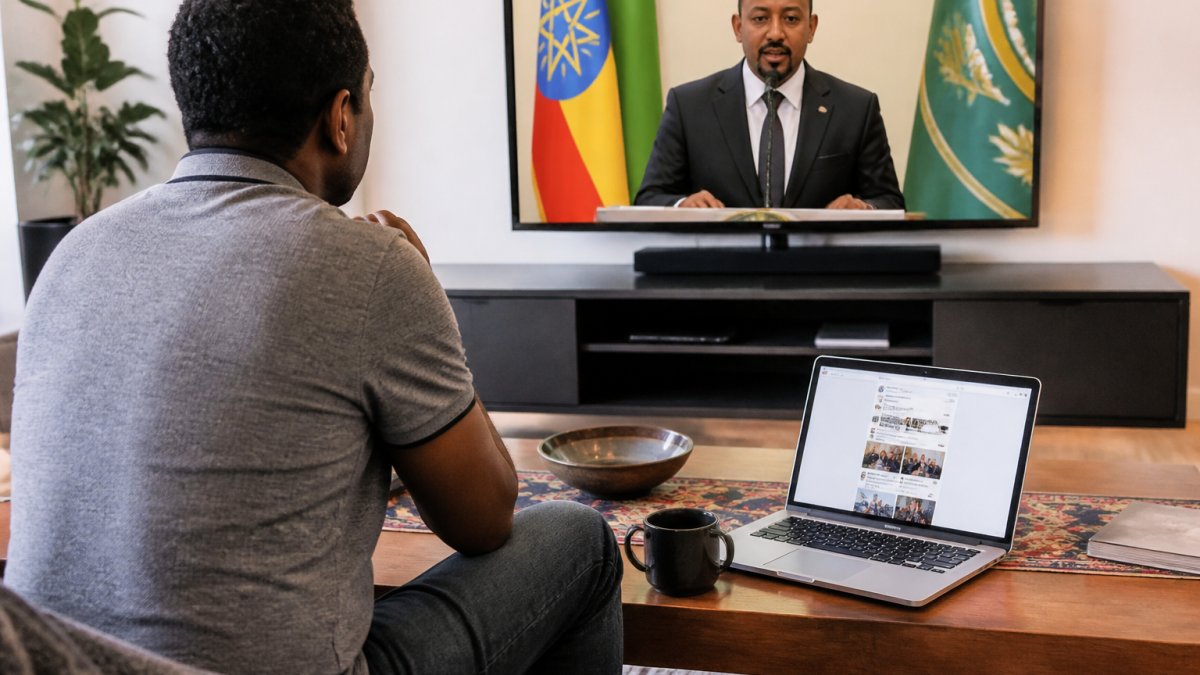
That history matters because it explains why diaspora media carries so much weight. A 2018 University of Oregon dissertation used mixed-method research to document the rise of ESAT and OMN and examine their political influence in Ethiopia, showing how quickly exile outlets became central to political life at home (University of Oregon dissertation on diaspora media and local politics).
From Satellite Television to Social Platforms
Satellite television and radio built the first mass audience, but social platforms changed the speed. The same outlets that once aired one weekly program now post continuously, and their audience replies in real time.
That combination of broadcast reach and social immediacy is what makes diaspora media politically potent. A 2026 study in SAGE Open found that both the Ethiopian government and diaspora communities now use digital platforms to shape diplomatic narratives, with diaspora campaigns pushing back on negative coverage and promoting Ethiopia's positions abroad (SAGE Open study on digital diaspora diplomacy).
Ethiopian Diaspora Social Media: Engagement Without Borders
Ethiopian diaspora social media is the layer of the ecosystem where participation actually happens, and it is where the impact on Ethiopia is most visible and most contested. Posts, hashtags, and livestreams let people who cannot vote at home still shape the conversation.
The numbers show how concentrated that conversation is. A Cambridge University Press study of the #NoMore movement found that users in Ethiopia and the United States together account for 77.31% of the dataset analyzed (Cambridge University Press study on the #NoMore movement).
The #NoMore Movement and the 77.31% User Split
That 77.31% figure is the clearest evidence yet that diaspora and domestic audiences are not separate worlds. They argue in the same threads, amplify the same hashtags, and react to the same events.
The split also reveals a gap. The study notes that 41.55% of all users come from one of those two locations, without specifying which, which means a large share of the conversation is driven by a small, concentrated group rather than the full diaspora.
Diaspora Media and Misinformation: The Double-Edged Sword
Diaspora media and misinformation are difficult to separate, because the same speed that makes diaspora outlets effective also makes errors travel fast. Unverified battlefield claims, doctored images, and rumor dressed as reporting have all circulated widely during recent conflicts.
The structural problem is money and outrage. A 2026 Ethiopia Insight analysis argued that diaspora media presents itself as political engagement while eroding the conditions for constructive discussion, with outrage, identity politics, and funding shaping coverage (Ethiopia Insight analysis of diaspora media).
That is not the whole picture. A GSDRC report on conflict-generated diasporas found that most Ethiopian diaspora organizations and media focus on cultural, professional, and economic self-help rather than partisan politics, which complicates the assumption that diaspora media is uniformly inflammatory.
Ethiopian Diaspora News Sources: Who to Trust and Why
Ethiopian diaspora news sources range from professional newsrooms with editorial standards to one-person pages that publish rumor, and the platform a story travels on shapes how much verification it gets before it reaches you. Comparing platforms side by side is the fastest way to see where trust is earned and where it is assumed.
| Platform type | Typical reach | Verification norm | Main risk |
|---|---|---|---|
| Satellite TV and radio | Broad, cross-generational, reaches audiences inside Ethiopia via satellite and shortwave | Editorial desk, but slow to correct on air | Framing bias, one-sided panel booking |
| Online news sites | Medium, search and link driven | Named bylines and corrections pages vary widely | Rumor republished as reporting |
| Facebook and X | Very high, algorithmically amplified | Almost none before posting | Doctored images, unverified battlefield clips |
| YouTube and TikTok | High among younger viewers | Creator-dependent, monetization rewards speed | Outrage edits, clipped context |
| Telegram and WhatsApp | High inside closed networks | None; forwarded as received | Untraceable origin, no correction path |
Use a simple test before you trust a story.
| Check | Weak Source | Strong Source |
|---|---|---|
| Sourcing | "Sources say" | Named people or documents |
| Corrections | Silent edits | Published corrections |
| Funding | Undisclosed | Disclosed ownership |
| Language | One community only | Multiple communities |
| Verification | Reposts rumors | Confirms independently |
Regulation, Press Freedom, and Platform Governance
Trust also depends on the legal ground an outlet stands on. Inside Ethiopia, press and internet laws have been used to restrict reporting and to prosecute journalists, which pushes critical coverage into exile and makes diaspora outlets the default source for stories domestic media will not touch. That dynamic cuts both ways: it protects speech that would otherwise be silenced, and it removes the local editorial checks that come from reporting inside the country. Navigating this complex landscape requires authors to master the nuances of gaining media exposure to ensure their perspectives reach a broader audience through established broadcast channels.
Platform governance adds a second layer. Major platforms publish community standards that prohibit coordinated inauthentic behavior, hate speech, and manipulated media, and they enforce those rules unevenly across languages. Amharic, Afaan Oromo, and Tigrinya moderation capacity has historically lagged behind English, so harmful content in those languages can stay up longer while legitimate political speech is sometimes removed by mistake. The trade-off is real: aggressive takedowns can suppress dissent, and light enforcement lets false information and incitement spread.
For readers, the practical response is media literacy rather than blind trust in any single rule set. Verify a claim against a second independent source, check whether the original footage or document exists, and look for an outlet that publishes corrections. The Habesha was founded in 2005 as an independent Ethiopian and diaspora media network, and our editorial approach centers on accurate reporting and open dialogue rather than outrage. We publish political analysis, cultural coverage, and human rights reporting for readers who want verified information, not a version of events built to provoke.
Positive Impacts: Advocacy, Diplomacy, and Nation Building
Diaspora media's clearest positive role is advocacy, and the record here is real. A senior thesis from Dominican University of California found that diaspora social media activity during the 2015-16 protests positively affected Oromo social progress by increasing a sense of autonomy and freedom (Dominican University of California thesis on the diaspora and the 2015-16 protests).
Beyond protest, diaspora media supports diplomacy, fundraising, and cultural continuity. It connects migrant networks across cities, keeps language and history alive for second-generation readers, and gives diaspora engagement a public platform that governments now take seriously.
Risks and Limits: Polarization, Hate Speech, and Audience Gaps
The risks are as documented as the benefits, but they are not evenly distributed. Polarized coverage, hate speech, and social division find fertile ground when outlets compete for attention rather than accuracy, and the mechanism is usually the same: a post that provokes a strong reaction gets more engagement, the algorithm rewards that engagement with more reach, and the next post is written to provoke harder. Over time the incentive rewards identity-based framing over reporting.
Hate speech and incitement are the sharpest edge of that cycle. During active conflict, dehumanizing language about ethnic groups has circulated on diaspora platforms and been amplified by domestic audiences, and the harm is not abstract: it hardens communal boundaries and makes later reconciliation harder. Moderation in Amharic, Afaan Oromo, and Tigrinya has lagged behind English, so the content that does the most damage is often the least policed.
Differences Within the Diaspora and Inside Ethiopia
Treating "the diaspora" or "audiences in Ethiopia" as single blocs hides the variation that actually drives impact. Language matters: Amharic-language outlets, Afaan Oromo-language outlets, and Tigrinya-language outlets reach different networks and carry different political weight. Generation matters: first-generation migrants often follow homeland politics closely, while second-generation readers engage more through culture and identity. Political affiliation matters: outlets aligned with different opposition or government positions compete for the same audience. Location and access matter: a reader in a major metropolitan area with reliable broadband has a very different media diet from a reader in a rural area relying on radio or a shared phone.
That variation explains why the same outlet can look constructive to one audience and inflammatory to another. It also explains why audience research remains the weakest part of the field. Most claims about diaspora media's influence rest on engagement metrics, not on measured changes in opinion or behavior, and the Cambridge study's concentration figure suggests that a narrow group drives much of the visible discourse. Until there are more surveys and panel studies, any claim about broad impact should be treated as a hypothesis, not a finding.
Conclusion: What the Evidence Says About Diaspora Media's Role
The impact of diaspora media on Ethiopia is real, uneven, and still poorly measured. It has given exiled voices a platform, pushed human rights issues into the open, and connected a scattered diaspora, while also spreading misinformation and deepening division.
The Habesha exists for readers who want the first without the second. We offer independent reporting, in-depth political analysis, and cultural coverage, all built to connect Ethiopians worldwide and encourage open dialogue instead of outrage. Start reading at The Habesha and see the difference verified journalism makes.
Frequently Asked Questions
What is diaspora media and how does it differ from domestic Ethiopian media?
Diaspora media refers to outlets run by or for Ethiopians living outside the country, including satellite television, radio, websites, and social media channels. Unlike domestic media, these platforms operate from abroad and often face fewer restrictions, allowing them to report on sensitive political topics. A 2018 University of Oregon dissertation documented the rise of outlets like ESAT and OMN as key diaspora voices. Some focus on partisan politics, while others, as a GSDRC report notes, prioritize cultural, professional, and economic self-help.
How does diaspora media influence political debate in Ethiopia?
Diaspora media shapes political debate by amplifying narratives that may not appear in domestic outlets. A 2026 SAGE Open study found that digital platforms enable diaspora campaigns to address negative narratives and promote Ethiopia's positions. However, the same platforms can also deepen polarization. Ethiopia Insight reported in 2026 that outrage and identity politics drive much transnational discourse. The influence is real but not uniform: a Dominican University of California thesis linked diaspora social media activity during the 2015-16 protests to increased feelings of autonomy among Oromo communities.
What are the risks of misinformation in diaspora media?
Misinformation spreads easily when diaspora audiences rely on unverified social media posts. A Cambridge University Press study on the #NoMore movement found that Ethiopia-based and U.S.-based users accounted for 77.31% of the dataset, showing how quickly narratives cross borders. Without source verification, false information and hate speech can escalate social division. Ethiopia Insight's 2026 analysis argued that diaspora media sometimes prioritizes outrage over accuracy. Readers should cross-check claims with multiple outlets and look for cited sources.
How can I tell if an Ethiopian diaspora news source is credible?
Check whether the outlet names its sources, distinguishes news from opinion, and corrects errors publicly. A GSDRC report found that many diaspora organizations focus on cultural and economic self-help rather than partisan politics, which can be a sign of balanced coverage. Look for transparency about funding and ownership. Cross-reference reports with at least two other outlets. Be wary of stories that rely on anonymous social media posts without verification. Credible sources will show their work and avoid inflammatory language.