 ultimate-guide
US Policy Toward Ethiopia 2026: A Complete Update
Table of Contents
- US Policy Toward Ethiopia 2026: What Changed
- Current State of Diplomatic Relations
- Ethiopia Sanctions Update 2026
- US Travel Advisory Ethiopia 2026 and Safety Concerns
- Current State of Human Rights in Ethiopia
- Humanitarian Assistance and Aid Framework
- Long-Term Strategic Implications and Diaspora Impact
- Conclusion: Navigating Uncertainty
- Frequently Asked Questions
Last Updated: October 4, 2026
US Policy Toward Ethiopia 2026: What Changed
US policy toward Ethiopia 2026 has shifted significantly, reflecting diplomatic progress alongside persistent security concerns. The U.S. has recalibrated its approach through strategic engagement, regulatory adjustments, and humanitarian commitments, changes critical for the Ethiopian diaspora, policymakers, and those tracking Horn of Africa developments.
The most consequential changes include the termination of Temporary Protected Status (TPS) for Ethiopians, removal from arms sanctions lists, and establishment of new diplomatic frameworks. These represent a coherent strategy to normalize relations while maintaining pressure on human rights and regional stability.
The U.S. has invested substantially in this relationship. According to the Congressional Research Service report on U.S. engagement and aid allocation, the United States provided $335 million in nonhumanitarian aid to Ethiopia in FY2023. This funding reflects Washington's strategic interest in Ethiopia as a regional anchor, despite ongoing concerns about governance and conflict.
Current State of Diplomatic Relations
The bilateral relationship has entered a new phase defined by structured engagement. In 2026, the two nations formalized this through the Bilateral Structured Dialogue Framework, establishing a mechanism for ongoing strategic cooperation and formal channels for addressing disagreements.
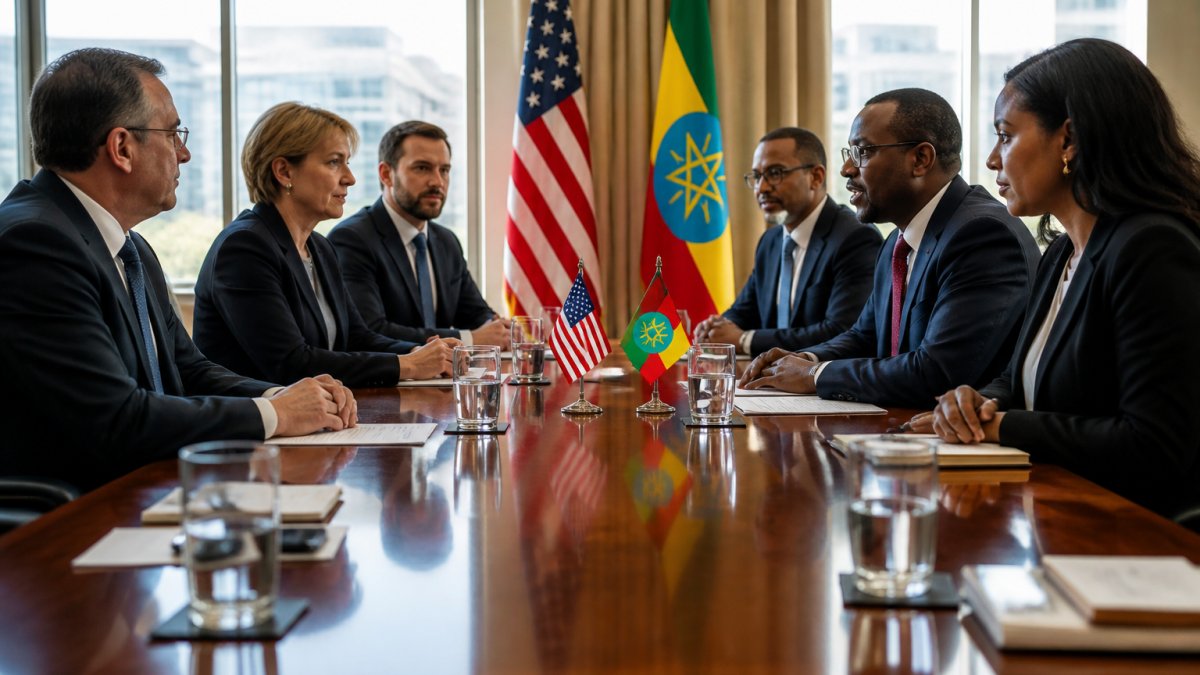
The dialogue framework addresses multiple domains: security cooperation, economic investment, democratic governance, and regional stability. It represents a deliberate effort by both governments to move beyond crisis management toward long-term strategic alignment. However, this normalization comes with explicit conditions. As stated by U.S. Department of State spokesman Tommy Pigott, "We strongly urge Ethiopia and Eritrea to respect the sovereignty and territorial integrity of their neighbors, exercise maximum restraint and return to dialogue."
This statement reveals the tension underlying the partnership: the U.S. engages diplomatically while maintaining pressure on regional behavior, channeling concerns through structured mechanisms rather than public confrontation.
Ethiopia Sanctions Update 2026
The regulatory environment surrounding Ethiopia shifted dramatically in September 2026 with a development that few predicted: the removal of Ethiopia from the ITAR Section 126.1(n) proscribed country list. According to Baker McKenzie Sanctions News, this regulatory change became effective September 18, 2026, normalizing defense-related trade relations between the two countries.
From 2020 through 2023, the U.S. maintained Ethiopia on multiple restricted lists as leverage during the Tigray conflict, imposing arms embargoes and using ITAR designation to pressure the federal government on civilian protection and humanitarian access. This sanctions-first approach reflected Washington's assessment that Ethiopia's government was unwilling or unable to prevent mass atrocities.
By 2024, policy shifted. The cessation of active hostilities in Tigray, combined with the government's agreement to allow humanitarian access corridors, prompted reconsideration of maximum pressure. Internal policy reviews concluded that sustained sanctions risked pushing Ethiopia toward Chinese and Russian security partnerships, weakening U.S. strategic position in the Horn of Africa.
The September 2026 ITAR removal culminates this 18-month reorientation. Rather than using sanctions as the primary tool, the U.S. shifted toward "conditional engagement", removing restrictions in exchange for commitments embedded in the Bilateral Structured Dialogue Framework.
The removal is not merely bureaucratic. The ITAR proscribed list restricts exports of defense articles and technical data, items critical to military modernization. Yet critics argue this move came prematurely, given ongoing regional tensions and human rights concerns.
The removal occurred weeks after signing the Bilateral Structured Dialogue Framework in August 2026, suggesting a deliberate strategy: formalize engagement first, then normalize trade as confidence-building. Under the new framework, sanctions removal becomes a reward for compliance rather than a coercion tool.
The U.S. maintained humanitarian assistance commitments, demonstrating that normalization doesn't abandon governance pressure. The distinction between defense trade and humanitarian aid reflects Washington's calculus: engage on security and economic fronts while preserving tools to influence internal conduct.
US Travel Advisory Ethiopia 2026 and Safety Concerns
The U.S. Department of State maintains a Level 3 Travel Advisory (Reconsider Travel) for Ethiopia as of August 27, 2026, reflecting persistent security challenges. The advisory warns against travel to Tigray and Amhara regions due to ongoing conflict-related risks, armed group activity, and limited humanitarian access.
The advisory's persistence reveals that improved government-to-government relations don't automatically translate to improved civilian security. While the central government has stabilized in some areas, regional instability persists with armed groups, banditry, and intercommunal tensions posing genuine risks.
For the diaspora, this advisory creates a difficult calculus: many want to visit family and maintain cultural connections, yet official guidance discourages travel to significant portions of the country.
The advisory signals that U.S. diplomatic engagement has limits: Washington can normalize trade relations and establish dialogue frameworks, but cannot guarantee security in regions where central authority control remains contested.
Current State of Human Rights in Ethiopia
Human rights conditions remain critical to US policy toward Ethiopia 2026, even as diplomatic relations normalize. The Bertelsmann Stiftung's BTI 2026 Ethiopia Country Report notes that structural governance issues persist despite recent diplomatic progress.
The U.S. maintains human rights pressure through multiple channels, but mechanisms have shifted from the sanctions-era approach.
Specifically, the dialogue framework includes a "Governance and Accountability" pillar that requires the Ethiopian government to provide quarterly reports on detention practices, freedom of expression, and ethnic-based discrimination. According to U.S. Department of State, these reports are not advisory, they directly affect the disbursement of the $335 million in annual nonhumanitarian aid.
This mechanism represents a significant innovation in U.S. policy design. The new framework creates "conditional engagement", the government receives benefits of normalized relations and defense trade access only if it maintains progress on governance metrics. Quarterly reporting means human rights backsliding triggers immediate consequences.
The State Department continues monitoring detention practices, freedom of expression, and ethnic-based discrimination through multiple channels. The Freedom House 2026 Freedom in the World report provides detailed assessments of Ethiopia's democratic status, which directly inform U.S. foreign policy engagement. Additionally, the U.S.
The current U.S. approach embeds human rights monitoring within the partnership itself, making compliance a prerequisite for continued normalization benefits. This allows ongoing governance conversation without rupturing relations, but creates a dependency dynamic where the Ethiopian government must maintain reform momentum to preserve defense trade and development assistance access.
For diaspora communities, this approach carries promise in sustained U.S. attention to governance and concrete accountability mechanisms, but risk that the framework may lack enforcement teeth if the State Department prioritizes strategic stability over democratic progress. Long-term effectiveness depends on whether the U.S. actually suspends aid when benchmarks are missed.
Humanitarian Assistance and Aid Framework
The U.S. commitment to humanitarian assistance in Ethiopia remains substantial. The 2026 Investment Climate Statement emphasizes Washington's support for creating an enabling environment for direct foreign investment, including monitoring the National Bank of Ethiopia's monetary policy reforms.
Humanitarian aid flows through multiple channels: bilateral assistance, multilateral organizations, and NGO partnerships. The $335 million in nonhumanitarian aid mentioned earlier operates alongside humanitarian programs addressing food insecurity, health, and displacement. The distinction between humanitarian and development aid reflects different U.S. policy objectives: humanitarian assistance responds to immediate crises, while development aid builds long-term institutional capacity.
The Carnegie Endowment for International Peace has analyzed U.S. democracy assistance during periods of democratic opening in conflict-affected states. Their research suggests that strategic assistance during transition periods can influence trajectories toward either democratic consolidation or authoritarian entrenchment. Ethiopia's current moment, with diplomatic normalization alongside persistent governance challenges, represents precisely such a transition period.
Long-Term Strategic Implications and Diaspora Impact
The reshaping of US policy toward Ethiopia 2026 carries profound long-term implications that extend far beyond immediate diplomatic or trade considerations. The strategic logic underlying normalization reflects Washington's broader regional interests: containing Chinese and Russian influence, maintaining access to critical Horn of Africa resources, and preventing state collapse that could destabilize the region.
For diaspora communities, these strategic calculations create complex realities. The U.S. normalization improves the operating environment for diaspora-linked investments and family remittances. Improved government-to-government relations typically facilitate business transactions, banking relationships, and travel. Yet strategic partnership doesn't guarantee protection for diaspora members' political interests or advocacy priorities.
The termination of Temporary Protected Status (TPS) for Ethiopia, effective August 18, 2026, directly impacts diaspora members living in the United States. According to the U.S. Citizenship and Immigration Services TPS termination notice, affected individuals must either adjust their immigration status through other legal pathways or prepare for eventual departure. This policy shift reflects the U.S. government's assessment that conditions in Ethiopia no longer warrant the extraordinary protection TPS provides.
The timing of TPS termination alongside diplomatic normalization signals confidence in Ethiopia's trajectory. The U.S. government essentially concluded that security conditions have improved sufficiently to no longer justify special protected status. However, diaspora members facing deportation may reasonably question whether conditions have actually improved enough to guarantee their safety upon return.
The diaspora's role in Ethiopia's future becomes increasingly important as U.S. policy normalizes. Diaspora investment, remittances, and advocacy shape Ethiopia's development trajectory. Yet diaspora communities often hold diverse political views, some supporting current government policies, others advocating for greater democratic reform. U.S. policy normalization doesn't resolve these internal diaspora tensions; it simply creates a new context within which they play out.
Conclusion: Navigating Uncertainty
The transformation of US policy toward Ethiopia 2026 reflects a strategic recalibration toward engagement and normalization. The Bilateral Structured Dialogue Framework, removal from sanctions lists, and continued humanitarian commitment represent a coherent strategy to deepen partnership while maintaining pressure on governance issues.
Yet this new approach carries inherent tensions. Diplomatic normalization and defense trade liberalization proceed simultaneously with human rights concerns and regional security warnings. The U.S. has chosen to manage these tensions through structured dialogue rather than sanctions pressure, a fundamentally different approach than previous years.
For the Ethiopian diaspora and those tracking U.S.-Ethiopia relations, this moment demands careful attention. The new policy framework creates opportunities for engagement and investment, but it doesn't guarantee democratic progress or human rights improvements. The most consequential question facing policymakers and diaspora communities alike is whether strategic partnership can coexist with meaningful pressure for governance reform. The answer will shape Ethiopia's trajectory for years to come.
The Habesha remains committed to providing credible analysis of U.S.-Ethiopia relations and their impact on diaspora communities. Our independent reporting connects Ethiopians across the world with accurate, in-depth coverage of policy developments that affect their lives. For ongoing updates on how these policy shifts unfold, follow The Habesha's coverage of Ethiopian politics, human rights, and U.S. engagement.
| Policy Area | 2025 Status | 2026 Change | Impact |
|---|---|---|---|
| Diplomatic Relations | Transactional engagement | Bilateral Structured Dialogue Framework | Formalized strategic partnership |
| Defense Trade | Restricted (ITAR list) | Removed from proscribed list | Normalized defense-related commerce |
| Travel Advisory | Level 3 (Reconsider) | Level 3 (Reconsider) | Persistent regional security concerns |
| TPS Status | Active protection | Terminated effective August 18 | Diaspora members must adjust status |
| Humanitarian Aid | Substantial funding | Continued commitment | Ongoing support for crisis response |
Frequently Asked Questions
What is the current US official stance on the political situation in Ethiopia?
The US government maintains a structured diplomatic engagement through the Bilateral Structured Dialogue Framework signed in Washington. The State Department urges both Ethiopia and Eritrea to exercise maximum restraint and respect territorial integrity. The US continues to monitor governance, human rights, and democratic progress while supporting an enabling policy environment for investment and economic development. Official statements emphasize dialogue over confrontation as the path to regional stability.
Can US citizens travel to Ethiopia right now in 2026?
The US State Department maintains a Level 3 Travel Advisory (Reconsider Travel) for Ethiopia as of August 27, 2026. Travel to the Tigray and Amhara regions is explicitly advised against due to ongoing security concerns. US citizens in other regions face elevated risks from civil unrest, crime, and limited ability of the US Embassy to assist Americans. Before traveling, check the US Embassy website for current conditions and register with the Smart Traveler Enrollment Program (STEP).
What happened to the sanctions on Ethiopia in 2026?
Ethiopia was removed from the ITAR Section 126.1(n) proscribed country list effective September 18, 2026. This regulatory change reflects a shift toward normalization of defense-related trade relations. However, this does not mean all sanctions have been lifted, ongoing security concerns and human rights monitoring continue to influence the broader policy framework. The removal signals the US government's intent to deepen strategic partnership while maintaining oversight of governance and compliance with international agreements.
Why is Ethiopia important to US foreign policy?
Ethiopia holds strategic importance as a regional anchor in the Horn of Africa, a geopolitically sensitive area affecting global security and trade routes. The country's stability influences regional conflicts, refugee flows, and humanitarian crises. The US provides substantial development and nonhumanitarian aid (approximately $335 million in FY2023) to support economic growth and democratic institutions. Ethiopia's role in peacekeeping, counterterrorism, and regional diplomacy makes it a key partner for advancing US interests in East Africa.